




Ober-Haus achieves highest turnover in history: 24 percent growth and strong start to the year


Ober-Haus’s revenue reached €6.67 million last year, a 24% increase from 2024. The rapidly growing residential real estate segment was the main contributor to this record-breaking result.
Ober-Haus, which provides a full range of real estate services, grew in all areas of its operations last year. The company’s revenue from brokerage in the primary housing market increased by 44%, and in the secondary market—by more than 30%. Ober-Haus’s revenue from property valuation services grew by 30% last year, while the volume of commercial real estate services increased by 5%.
In total, the company provided 13,500 services in Lithuania last year: it brokered 1,000 real estate sales and 500 rental transactions, and also prepared 12,000 property valuation reports, expert assessments, and consultations for clients.
Audrius Šapoka, CEO of Ober-Haus, notes that while last year’s business environment was favorable for the entire real estate sector, the company outperformed overall market growth in most of its business segments.
“In last year’s booming market, our previous clients returned to us, accounting for the majority of our transactions. We were also often the first choice for new partners. On the other hand, our growth, which outpaced the entire market, was also driven by our investments in new property marketing channels, technologies, and more efficient processes,” says A. Šapoka.
This year, Ober-Haus expects growth to remain at a similar pace, even after accounting for the events in the Middle East in March, and the company plans to make additional investments in technological solutions for home sellers and developers.
The company also got off to a positive start in 2026: during the first quarter, the company’s rental and new home sales segments each grew by 80%, while revenue from existing home brokerage increased by another 32%. The results of Ober-Haus’s property valuation department in January–March were 22% higher than a year ago; commercial real estate rental brokerage services grew by 12% during this period, while sales grew by as much as 55%.
“This consistent growth is driven by two key factors: overall market activity and the company’s strategy—not to be the most expensive, but to be the highest-quality advisors, backed by data and experience. We follow a simple and clear rule in our work—all Ober-Haus clients are our partners: whether it’s the seller of a small apartment or a large business client, they must receive advice from us that creates real value and helps them achieve their goals in the real estate market faster. As we can see from the results, it works,” says A. Šapoka.
According to the company’s CEO, market competition is fierce across all segments. And in order to remain competitive and operate profitably, it is necessary to adapt to the latest trends and help employees develop new skills.
“Today, a good real estate consultant is no longer someone who works with just any property or someone who knows how to take nice photos and post an ad. Of course, you need to know how to do this professionally, but greater value is created elsewhere. A good broker is someone who bases their advice and insights on data, the latest information, and real-world experience. For example, a good broker must have a solid understanding of land-use planning—in order to understand, say, a plot’s potential for use and development. A real estate agent must also have a solid grasp of civil law and finance, understand how to properly formalize lease, sales, and other similar agreements, how to interpret various contractual terms, and ultimately how to protect their client from the other party’s contract terms—which are often extremely sophisticated and not necessarily fair or in line with market practices—and how to identify risks within them,” said A. Šapoka.
According to A. Šapoka, events in the Middle East and energy markets in March did not have a significant impact on the residential real estate segment, but decision-making in the commercial segment has slowed down.
“There is certainly some influence from Iran. For example, one German company has put a planned acquisition on hold until the global situation becomes clearer. On the other hand, investors familiar with the local or Lithuanian market have grown accustomed to global turmoil, so an end to the conflict would likely restore previous levels of interest fairly quickly,” comments the head of Ober-Haus.
Latest news
 All news
A new 40-apartment development, “Matau marias”, is being built on the shores of the Ekranas Lagoon in Panevėžys
A new real estate development, “Matau marias”, is being built in Panevėžys by the Ekranas Lagoon. At Elektronikos g. 10, four low-rise buildings are planned, comprising 40 leisure-use apartments with partial interior finishing. The apartments will range in size from 28 to 96 sq. m. Construction began in August 2026 and is scheduled for completion by the end of 2027. One of the development’s key features is its location directly beside the Ekranas Lagoon. The buildings are surrounded by greenery, while the site is closely integrated with the lagoon’s shoreline. The development will include pedestrian paths, landscaped green and recreational areas, an upgraded waterfront, and a private jetty for apartment owners. “Living by the water is usually associated with the countryside or resort towns, so a location like this in Panevėžys itself is quite rare. Here, the water and nature are not simply part of the view – the lagoon’s shoreline becomes a natural extension of the development. At the same time, the city centre remains just a few minutes away,” says Justina Ščeponavičė, Head of Sales for the project. Four low-rise buildings and just 40 apartments “Matau marias” consists of four low-rise buildings connected by a cohesive landscape concept…
Optimism continues to support housing price growth
The August 2026 value of the Ober-Haus Lithuanian Apartment Price Index (OHBI), which tracks apartment price changes in the five largest cities in Lithuania (Vilnius, Kaunas, Klaipėda, Šiauliai and Panevėžys), increased by 1.8%. Over the past 12 months, the overall apartment price level in Lithuania’s major cities rose by 13.7% (in July 2026, annual growth stood at 12.9%). In August 2026, apartment sale prices in Vilnius, Kaunas, Klaipėda, Šiauliai and Panevėžys increased by 1.6%, 2.1%, 2.3%, 1.0% and 1.3%, respectively. The average price per square metre reached €3,170 (+€50/m²), €2,300 (+€47/m²), €2,080 (+€48/m²), €1,429 (+€14/m²) and €1,393 (+€18/m²), respectively. Over the year (August 2026 compared with August 2025), apartment prices increased in all major cities across Lithuania: by 12.7% in Vilnius, 16.4% in Kaunas, 12.9% in Klaipėda, 15.8% in Šiauliai and 14.6% in Panevėžys. “Despite considerable expectations regarding the impact of the second-pillar pension reform and changes to the Responsible Lending Regulations on the Lithuanian housing market, we have not observed a significant surge in market activity recently. According to data from the State Enterprise Centre of Registers, 2.5% more apartments and houses were purchased in Lithuania this August than in the same month last year, but 4.7% fewer than…
New residential development “Keturlapio skveras” completed in Didieji Gulbinai
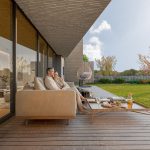
A new residential development, “Keturlapio skveras”, has been completed in Didieji Gulbinai, Vilnius, next to Verkiai Regional Park and Lake Gulbinas. The project, located on Sėkmės Street, comprises 24 A++ energy-class semi-detached homes, with sales progressing actively. The development features four- and five-bedroom, one- and two-storey homes ranging from 130 to 170 sq. m, set on plots of 6 to 9 ares. The homes are being sold with partial finishes, completed terraces and fully landscaped surroundings. “Keturlapio skveras” has been designed as a cohesive, gated residential development. The site will be fenced, with controlled access, street lighting and a video surveillance system. The internal road ends in a cul-de-sac, ensuring that there is no through traffic within the development. Residents will also have access to an 18-are recreational park featuring illuminated pathways, a children’s playground and a landscaped leisure area. “This project is aimed at buyers looking for a premium home who value a thoughtfully planned environment, proximity to nature and a strong sense of community. Here, it is not just about the house and its plot – the project also creates the infrastructure of the entire development and a shared recreational space. Particular attention has been paid to the…
All news