



What does the final office rental price include?



Companies that have decided to move from old offices to modern business centres after many years, or those new to the office rental market, are faced with a model that has been used in this sector for some time. This model is much more detailed than ‘price per square metre plus utilities. Ugnė Liaudanskienė, the Ober-Haus office leasing manager, shows businesses looking for new premises what tenants pay for and how they pay for it.
As residents and business representatives are much more familiar with the basic principles of apartment rentals, they have similar expectations for offices. Even in old business centres, long-established companies sometimes ask themselves what else could make up the rental price besides the price per square metre, utility bills and perhaps symbolic maintenance costs.
Publicly, only the ‘bare’ rental price per square metre is usually declared. In Vilnius’ Class A business centres, this has settled at 16–20 EUR/sq. m this year and is likely to remain so until next year. In Class B centres, it is 10–15.50 EUR/sq. m. According to Ober-Haus data, rental prices for Class A offices in the capital have increased by 17% since the end of 2020 and by 13% for Class B offices.
However, tenants who are not yet familiar with modern business centres and their practices should not be surprised to find that various taxes add an extra €4–6 per square metre to the above amounts each month. Newcomers to the market may also be surprised to learn that attractive and functional common areas of the building intended for employees or guests are included in the leased area on a proportional basis. Additionally, separate costs for parking spaces or signage on the façade should be factored in.
According to U. Liaudanskienė, office rental prices were much simpler to calculate, similar to the apartment market, in Lithuania a dozen or so years ago, before the emergence of modern business centres. These simple methods remain in use in individual business centres and when renting separate administrative premises. She therefore suggests that experienced market participants bear this in mind and that newcomers familiarise themselves with the practices that determine the final rental price in modern business centres.
“Overall, we can be happy that Lithuania has not only adopted Western office rental practices and methodologies, but has also implemented them correctly and sensibly.’ For example, unlike in some Scandinavian markets, office space in Lithuania is not taxed up to the perimeter of the building’s exterior walls or the plot of land under the building. Additionally, office rental prices and other costs in Vilnius remain significantly lower than in London, Oslo and other major European cities,” comments U. Liaudanskienė.
It’s not necessarily an obvious ‘square’
The price per square metre is probably the most obvious component of the final office rental cost. However, in new business centres, it is important to familiarise yourself with their office space calculation methodology, as this may differ from the cadastral measurements provided to the Registry Centre.
Property managers are transparent about this and do not seek to mislead customers, but tenants should find out if the floor area is calculated up to the inner side of the outer walls and if the area under walls, columns, partitions, supporting structures and elevator shafts, staircases and balconies is included. This methodology may vary from property to property, so for the same price – say, €20 – you may get a slightly different ‘square’ that is actually useful for business.
Also, even if a company needs 100 square metres of office floor space, the shared floor space may be proportionally allocated at the same price per square metre – for example, the area leading to the door of the rented office, corridors, areas near elevators and common sanitary facilities and kitchenettes used by company employees or their guests.
Another novelty for tenants moving into modern business centres for the first time relates to the communal areas of the entire building (rather than a specific office floor). These areas are distributed among all offices in the building in proportion to the space used, and are known as the ‘add-on’. These may include communal areas on the ground floor, break or waiting areas, gyms (if applicable), shared toilets or showers, bicycle storage rooms, and so on. While new business centres are increasingly talking about employee well-being and actually delivering on it, for tenants, all of these amenities come at an additional cost, usually adding another 3-10% to the actual square footage of the leased office space.
What else is in store?
Today, managers of modern business centres mostly adhere to the “triple net lease” principle, meaning that, in addition to the usual monthly rent, tenants pay all main property-related costs in proportion to their space usage.
The most obvious of these are utility charges based on actual consumption, as measured by meters – water, electricity and heating. Currently, this adds about €1–2 per square metre to tenants’ bills.
In addition to the aforementioned communal areas of the floor or building, office tenants may also be required to pay separately for this space’s operating costs. They are also required to pay for building administration, technical maintenance and repairs, security, waste disposal, cleaning and maintenance of the premises, building insurance, land or land lease, and real estate taxes, all in proportion to the leased area as set out in the lease agreement.
In Vilnius, these fees currently range from €2.50 to €4.50 per square metre per month. According to Ober-Haus data, utility and common costs in business centres have increased by around €2 per square metre over the last five years, due not only to rising energy prices, but also to certain modern engineering solutions, such as the installation of automatic irrigation systems.
How can you avoid getting lost?
In addition to the above, tenants will usually have to budget for parking spaces or outdoor advertising. Some business centres charge for the rental of signs on the façade, costing from a few hundred to one-and-a-half thousand euros per month. It is also important to note that the vast majority of lease agreements are indexed annually, meaning that not only the price of office space, but also the price of parking spaces and other fees, will be adjusted for inflation.
The office layout and furniture situation can create additional nuances, but also opportunities for efficiency. A wide variety of scenarios are possible, ranging from moving into a furnished office that requires no changes, to setting up in a partially finished space in a newly built building. Tenants who invest more of their own funds in infrastructure can expect certain discounts and benefits, such as free rent during renovation work. Conversely, in some cases, these costs may be covered by the business centre, but the tenant may then be bound by longer or less flexible lease terms. Either way, furnishing an office will incur financial and/or time costs, so it is worth anticipating these in advance.
Business centre managers clearly state all these aspects in lease agreements and allow room for negotiation on certain issues. Therefore, tenants are advised to carefully analyse, consult and compare first.
The days when you only paid for the ‘floor under your feet’ in modern business centres are long gone, but the market itself has developed in line with best practices in Western Europe. The ‘catches’ in the Lithuanian office market are not hidden or deliberate, and a thorough analysis will more often than not help you to make the right decision. Ultimately, the long-term value created by a new office that meets your employees’ needs is likely to outweigh any additional costs or concerns that may arise.
Latest news
 All news
A new 40-apartment development, “Matau marias”, is being built on the shores of the Ekranas Lagoon in Panevėžys
A new real estate development, “Matau marias”, is being built in Panevėžys by the Ekranas Lagoon. At Elektronikos g. 10, four low-rise buildings are planned, comprising 40 leisure-use apartments with partial interior finishing. The apartments will range in size from 28 to 96 sq. m. Construction began in August 2026 and is scheduled for completion by the end of 2027. One of the development’s key features is its location directly beside the Ekranas Lagoon. The buildings are surrounded by greenery, while the site is closely integrated with the lagoon’s shoreline. The development will include pedestrian paths, landscaped green and recreational areas, an upgraded waterfront, and a private jetty for apartment owners. “Living by the water is usually associated with the countryside or resort towns, so a location like this in Panevėžys itself is quite rare. Here, the water and nature are not simply part of the view – the lagoon’s shoreline becomes a natural extension of the development. At the same time, the city centre remains just a few minutes away,” says Justina Ščeponavičė, Head of Sales for the project. Four low-rise buildings and just 40 apartments “Matau marias” consists of four low-rise buildings connected by a cohesive landscape concept…
Optimism continues to support housing price growth
The August 2026 value of the Ober-Haus Lithuanian Apartment Price Index (OHBI), which tracks apartment price changes in the five largest cities in Lithuania (Vilnius, Kaunas, Klaipėda, Šiauliai and Panevėžys), increased by 1.8%. Over the past 12 months, the overall apartment price level in Lithuania’s major cities rose by 13.7% (in July 2026, annual growth stood at 12.9%). In August 2026, apartment sale prices in Vilnius, Kaunas, Klaipėda, Šiauliai and Panevėžys increased by 1.6%, 2.1%, 2.3%, 1.0% and 1.3%, respectively. The average price per square metre reached €3,170 (+€50/m²), €2,300 (+€47/m²), €2,080 (+€48/m²), €1,429 (+€14/m²) and €1,393 (+€18/m²), respectively. Over the year (August 2026 compared with August 2025), apartment prices increased in all major cities across Lithuania: by 12.7% in Vilnius, 16.4% in Kaunas, 12.9% in Klaipėda, 15.8% in Šiauliai and 14.6% in Panevėžys. “Despite considerable expectations regarding the impact of the second-pillar pension reform and changes to the Responsible Lending Regulations on the Lithuanian housing market, we have not observed a significant surge in market activity recently. According to data from the State Enterprise Centre of Registers, 2.5% more apartments and houses were purchased in Lithuania this August than in the same month last year, but 4.7% fewer than…
New residential development “Keturlapio skveras” completed in Didieji Gulbinai
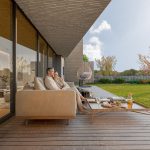
A new residential development, “Keturlapio skveras”, has been completed in Didieji Gulbinai, Vilnius, next to Verkiai Regional Park and Lake Gulbinas. The project, located on Sėkmės Street, comprises 24 A++ energy-class semi-detached homes, with sales progressing actively. The development features four- and five-bedroom, one- and two-storey homes ranging from 130 to 170 sq. m, set on plots of 6 to 9 ares. The homes are being sold with partial finishes, completed terraces and fully landscaped surroundings. “Keturlapio skveras” has been designed as a cohesive, gated residential development. The site will be fenced, with controlled access, street lighting and a video surveillance system. The internal road ends in a cul-de-sac, ensuring that there is no through traffic within the development. Residents will also have access to an 18-are recreational park featuring illuminated pathways, a children’s playground and a landscaped leisure area. “This project is aimed at buyers looking for a premium home who value a thoughtfully planned environment, proximity to nature and a strong sense of community. Here, it is not just about the house and its plot – the project also creates the infrastructure of the entire development and a shared recreational space. Particular attention has been paid to the…
All news