



The number of new apartments built is not record high, but still the largest over the past decade


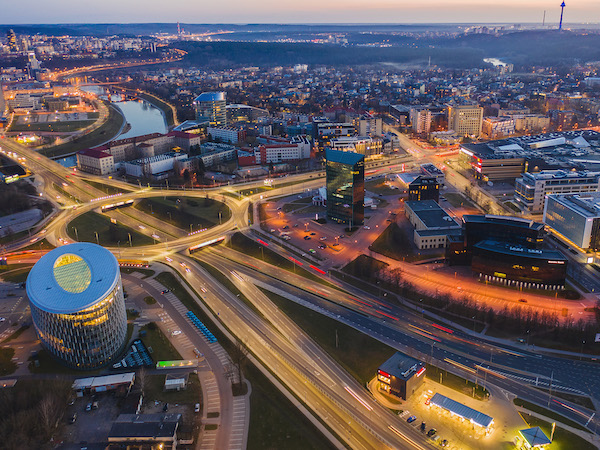
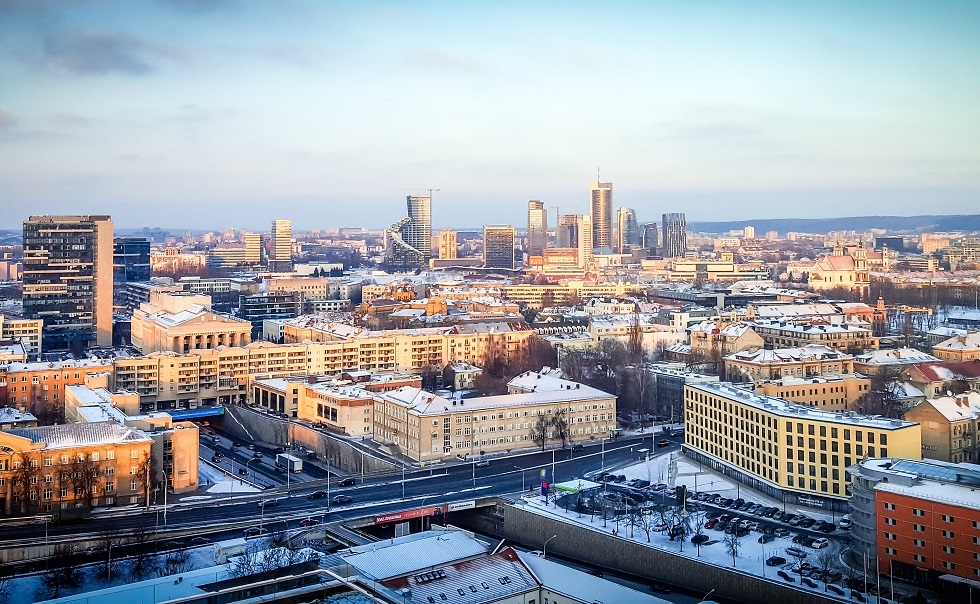 To sum up the results of 2018, it can be said that the year was one of the most active for housing developers in Lithuania and the city of Vilnius continued to be in the lead among the capitals of the Baltics by the quantities of new housing. Ober-Haus has obtained the factual data on the completed multi-apartment buildings in 2018 in Vilnius. “We provide detailed data for the year 2018 and answers to the following key questions: how many and what type of apartments were built, who built them, and where they were built. At the same time we provide a review not only of the last year’s performance, but analyse it within the context of the past 15 years and offer this year’s forecasts,” Raimondas Reginis, Research Manager for the Baltics at Ober-Haus, said.
Ober-Haus has for more than 15 years collected comprehensive data on housing development both in Vilnius and in other major cities in Lithuania. Currently only the database of Vilnius city and its suburbs contains information about the multi-apartment building projects built in 2003–2018 when almost 50,000 apartments were offered for sale. The statistics on apartments in multi-apartment buildings in this overview does not include the data on private houses, terraced houses and non-standard projects (e.g. loft conversions). The data about the projects exclusively for rent or social housing are also outside the scope of this overview.
According to Ober-Haus, in Vilnius developers built 4,355 new apartments or 5% more than in 2017. Although the volumes of apartment construction haven’t reached the 2006–2008 level (during that period 4,800–5,800 apartments were built annually), in terms of the diversity of new projects in Vilnius the year 2018 was truly exceptional. If between 2003 and 2017, buyers could choose from not more than 50 different multi-apartment building projects, in 2018 they could choose from 58 different newly built projects.
A total of 43% of all apartments built in three urban neighbourhoods
In 2018, the multi-apartment building projects in Vilnius were very diverse (in terms of quantity, quality and geography). Developers built new multi-apartment buildings in 15 out of 21 neighbourhoods of Vilnius. Traditionally, the most popular and most rapidly developing areas of the city were most attractive to developers. Over 70% of all new apartments were built in seven urban neighbourhoods: Pašilaičiai (15.3%), Pilaitė (13.9%), Šnipiškės (13.5%), Verkiai (7.9%), Naujamiestis (7.8%), Žirmūnai (6.5%) and Lazdynai (6.5%).
According to Reginis, in recent years developers have been more active in investing in multi-apartment projects in the neighbourhoods of Vilnius where the new housing development has been scarce (e.g., Naujoji Vilnia, Naujininkai, Vilkpėdė, Lazdynėliai, Naujasis Antakalnis) or even in the neighbourhoods located outside the city (e.g., Klevinė Užubaliai, Naujasis Lentvaris). Developers try to offer apartments to customers in the locations where there is far less direct competition than in the most popular neighbourhoods of the city.
In 2018, economy class apartments dominated
In 2018, the fastest growth was recorded in the construction of economy class apartments in Vilnius. Ober-Haus estimates that the share of the economy class apartments (the price level of up to 1,500 EUR/sqm without final fit-out), increased from 30% to 45% compared with 2017. In the meantime, the share of the medium class apartments (the price level from 1,500 EUR/sqm to 2,000 EUR/sqm) decreased in a year from 52% to 36%. The most stable situation remained in the projects involving higher class apartments (the price level in excess of 2,000 EUR/sqm) – their share grew from 18% to 19% in 20188.
According to Reginis, looking at the distribution of apartments built in 2018 by classes, last year’s supply was really well balanced and sufficiently accurately reflected the structure of the purchasing power of the population.
Record small apartments were built
Over the past 15 years, the floor area of the new apartments has been steadily and rather quickly decreasing, which is no longer a surprise, but the year 2018 will go down in history for the smallest average size of apartments built in the multi-apartment buildings in Vilnius. According to Ober-Haus, in 2018, compared with 2017, the average size of apartments built in the multi-apartment buildings decreased by 3.5 sqm totalling 50.2 sqm. Compared with the size of multi-apartment buildings built in 2003–2009, the decrease is by one fifth on average or slightly over 12 sqm.
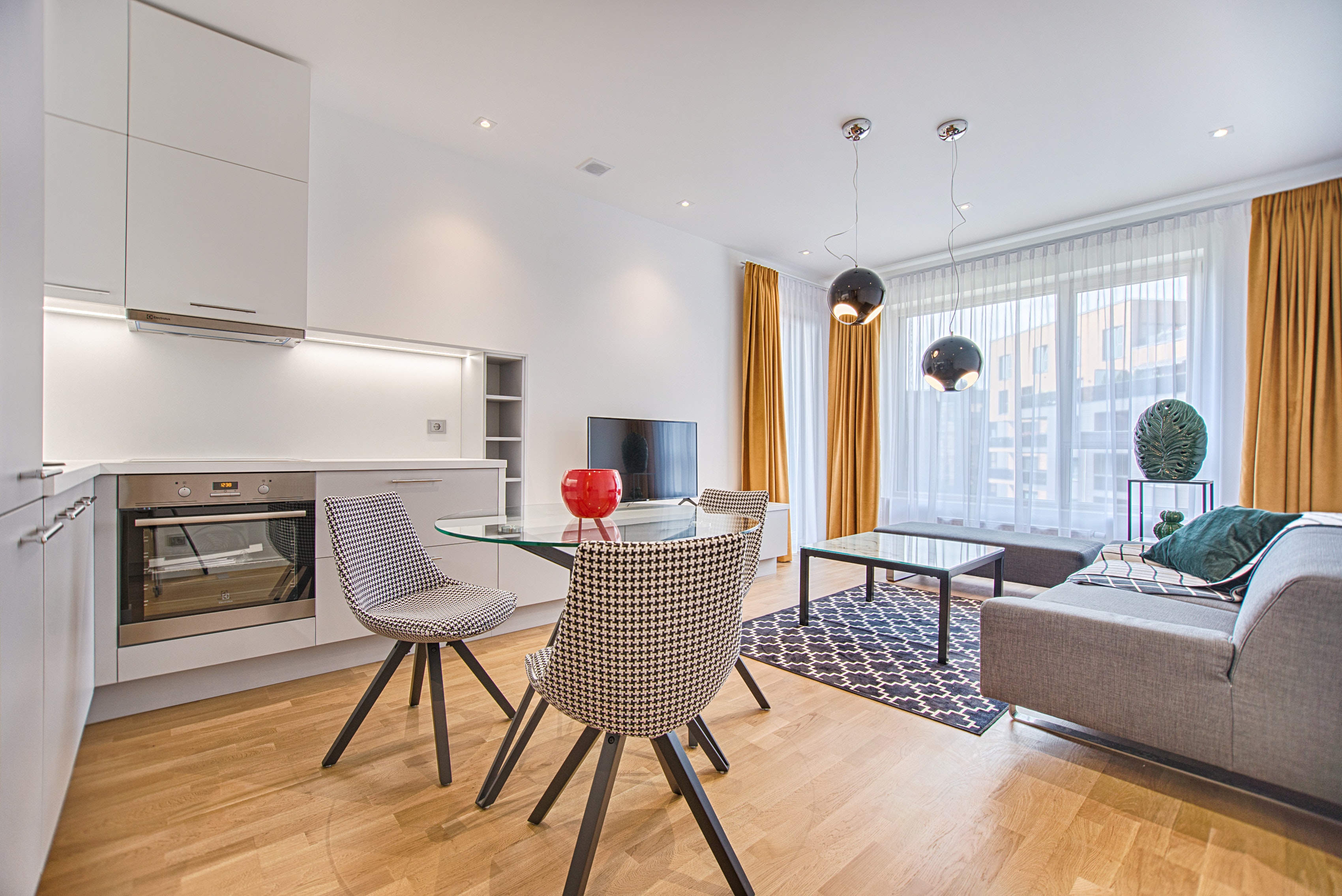 The rapid decrease in the average floor area of apartments in Vilnius has been recorded since the last economic downturn, when developers started to design and build greater numbers of smaller apartments and increase the share of such apartments in apartment buildings. This means that apartments with fewer rooms are offered more frequently, the floor planning of apartments has become more rational (inefficient and hardly used spaces in the apartments were eliminated or reduced), and sizes of the rooms became smaller. “It is no surprise, therefore, that there are 3-room apartments of 50-55 sqm on the market and that new apartments with a separate kitchen are a thing of the past. Therefore it comes as no surprise that the decreasing size of newly built apartments prompted the development of private or terraced houses offering more spacious housing for larger families,” Reginis pointed out.
A profile of multi-apartment developers – the share of developers with average experience grew fastest
Most experienced developers on the market contributed most to the supply of new apartments in 2018, although their share decreased over a year. According to Ober-Haus, experienced real estate development companies with at least 4 different residential projects in their portfolio built 44% of apartments in the capital city in 2018 (in 2017 this indicator was 66%). Developers with less experience (2-3 completed projects) built 43% of all apartments and their share increased fastest within a year (in 2017 year this indicator was 24%). The share of the companies without longer history of housing development (not more than one implemented project) or the newcomers of the market increased from 10% to 13% in 2018.
Speaking about developers with less experience or first-time property developers in the housing market, it should be noted that a certain portion of such companies may be established by company groups with a firm financial backing, which specialise in other business segments or are better known as commercial property developers who in recent years have re-routed their investment into the housing development. Such companies can afford to recruit highly skilled service providers (designers, contractors, supervisors and other consultants) and successfully implement housing projects thus gaining experience and becoming known as housing developers in the market. However, the active housing market also attracts first-time developers who cannot prove in advance to the investor or the buyer that they will be able to manage the complex project planning and construction properly.
What lies ahead in the multi-apartment building market in Vilnius in 2019?
At the start of the year we are able to provide a sufficiently accurate forecast what to expect in the multi-apartment building market in the capital city. After assessing the construction of multi-apartment buildings in progress or pending, scheduled completion and historical experience in the housing development, Ober-Haus forecasts that a total of about 4,500-4,600 apartments will be built in 2019 or an average of 5% more than in 2018. “Of course, the main condition for such forecast is at least stable general economic situation,” Reginis added.
“Looking at the volume of housing construction which continues at an unabated pace, the question remains whether the volume meets the demand. Is the number of apartments being built too large or too little? Out of the total apartments built in 2018, 74% of them were sold or reserved at the end of 2018. In 2017, the indicator was almost the same totalling 75%. In 2016, the result was better and totalled 82%, while in 2015 it stood at 73%. Therefore, the results of 2018 are not somehow exceptional, but are an average of the past three years. This leads to the conclusion that developers build neither too much nor too little. This is really good news for the entire market,” Reginis said. To sum up the past year and looking at the year 2019, it is clear that the housing development “boom” continues and in the nearest future customers will certainly have plenty of options to choose from.
Latest news
 All news
In 2025 developers built only half as much as buyers purchased
In 2025, the Lithuanian housing market was characterised by a particularly rapid increase in housing sales volumes in both the secondary and primary markets. According to the Ober-Haus review, a particularly rapid recovery was recorded in the primary market of large cities, where buyers were active in purchasing newly built apartments in completed and newly constructed buildings. Of all the apartments actually built and sold on the primary market, the capital city showed the greatest imbalance in 2025. According to Ober-Haus data, developers in Vilnius built 2,787 apartments for sale in apartment buildings in 2025, which was 8% more than in 2024. Meanwhile, over 5,700 apartments were sold on the primary market in Vilnius during the year, representing an increase of 82%. 'This means that developers actually built half as much as the recorded housing demand. Since the project planning and construction process is lengthy and often takes longer than planned, the rapid recovery of the market has left developers unable to meet demand," says Raimondas Reginis, Ober-Haus's market research manager for the Baltic countries. This situation is unfavourable for both buyers and developers. Buyers have limited choice and face rapidly rising prices, while developers are unable to fully exploit…
Sales of Dubysa Namai apartments in Ariogala have begun
The Dubysos Namai housing project in Ariogala is nearing completion. This five-storey residential building has been developed on a 0.75-hectare plot of land in the picturesque Dubysa Valley. This development will provide much-needed new housing for the town's real estate market, where supply has been extremely limited until now. Sales of the apartments have already begun, and prospective buyers can choose from a range of modern, well-designed homes. First-time homebuyer subsidies are available for young families. The development comprises 89 apartments, each with a storage room and parking space. The development will feature a children's playground, leisure areas, lighting and a gated entrance, creating a safe and comfortable environment for residents. Dubysos Namai offers two to four-room apartments ranging from 55 to 110 m² in size with partial finishing. The first phase of apartments has been completed and is ready for new residents to move in, while the second phase of construction is expected to be finished in Q4 of 2026. Almost all apartments have balconies and the option to install a fireplace, offering panoramic views of the Dubysa Valley. Many buyers are surprised that it is possible to install a fireplace in Dubysos Namai apartments. This is a rare…

The Šiauliai housing market is expected to see a more moderate second half of the year
Although housing prices in Šiauliai rose by 11% in 2025 and remained active at the beginning of this year, the market is expected to stabilise in summer or autumn, according to forecasts by Ober-Haus. According to data from the Centre of Registers, a total of 1,539 apartments and 253 houses were purchased in Šiauliai in 2025, representing increases of 22.9% and 22.4%, respectively, compared to 2024. According to Ober-Haus calculations, the average price of apartments in Šiauliai was €1,273 per square metre at the end of last year, which is 11% higher than a year ago. According to the company's data, the price of typical old apartments in residential areas of Šiauliai currently ranges from €1,200 to €1,800 per square metre, depending on furnishings, location and the condition of the building. Prices for newly built apartments with partial finishing in residential areas range from €2,000 to €2,800 per square metre, whereas in the city centre or the old town, prices per square metre can reach €2,500 to €3,200. Linas Juozaitis, head of the Šiauliai Ober-Haus office, comments that the highest market activity and price growth in the city was observed in the second half of last year, and similar trends…
All news