



Causes and consequences of office tenant migration



The article was published on the business news portal Verslo žinios.
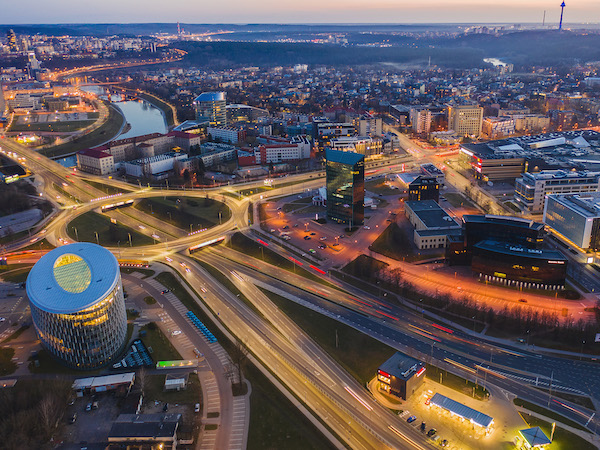
It is no secret that the Vilnius business center market has been driven in recent years primarily by “relocations”—existing tenants moving into new offices. This move is increasingly paying off for companies, but owners of aging buildings are not panicking and are beginning to offer relevant and interesting alternatives.
Last year’s office leasing landscape in the capital speaks volumes: the largest lease deals were signed by market veterans such as Circle K, Ergo, “PwC Lithuania,” and “Cobalt,” as well as the Ministry of Economy and Innovation, which moved out of its historic building on Gedimino Avenue, and others. The situation was similar back in 2024, with the most notable lease deals involving “Artea,” the FNTT, “Narbuto,” and ILTE. Some moves were driven by business expansion, while others were simply the natural result of a long-overdue renewal, but the phenomenon of relocation itself is evident and welcome.
It is also clear that market veterans considering a new office now have plenty of options to choose from: Business Stadium Central opened its doors at the beginning of this year, and major projects such as Sąvaržėlė and Tech Zity Vilnius, as well as several smaller business centers, will soon be completed. The nearly 50,000 square meters set to enter the market in the next six months alone will maintain or even increase the 10.8% office vacancy rate recorded in Vilnius at the end of 2025.
Why and How They’re Moving
Every business makes its own calculations, and no company relocates just because it’s trendy. However, today companies have a favorable opportunity to improve their conditions, create value, and, under certain circumstances, perhaps even avoid spending more.
First and foremost, rental prices remain stable: they did not change significantly last year, and no growth is expected this year either. Despite increased vacancy rates and competition, landlords are not always willing or able to offer direct discounts per square meter of office space. However, today it is possible to negotiate benefits in other areas: more flexible financing options for office fit-outs are being offered, along with free rent for the first few months, and attractive customized offers are emerging.
Also, it is now easier to reach agreements on shorter lease terms (e.g., a 3+2-year formula, though there is demand for even shorter periods). Simply put, landlords are definitely more flexible right now, which allows tenants to secure more favorable terms. This situation is particularly appealing to businesses that were already planning to relocate.
When moving to a new office, the “square footage” itself will, of course, be more expensive. In Class A business centers, the price per square meter has settled at 16–22 EUR/sq. m, while in Class B centers it is 10–16 EUR/sq. m. However, we are seeing that some companies are leasing less space than before.
According to various sources, the average size of leased office space fell by nearly half last year compared to 2020. Even long-standing market players who are relocating are often looking for smaller, more efficiently designed, and more versatile spaces. Some new and older business centers are adapting to the changing market and dividing certain vacant spaces into smaller offices, ranging from approximately 50 to 200 square meters. For example, if an entire floor has been vacant for a long time, landlords tend to invest in dividing that floor into several smaller offices.
Remote work, which began five years ago, is evolving; companies increasingly want to see their colleagues in the office more often, but even this is not halting the trend toward smaller office spaces. As the newest business centers place even greater emphasis on shared spaces for relaxation, sports, or meetings, the need for dedicated areas for these purposes within each individual office is decreasing. In other words, in new business centers, more and more functions are being moved to shared spaces, so part of the area that was previously set up in each office is now shared as needed.
In general, new business centers can offer services such as a wide variety of sports activities, wellness clinics, daycare centers and schools, retail, dry cleaning, and more, either on-site or nearby. This can help employees save on transportation and time costs, thereby creating value.
However, common areas, recreational spaces, “entertainment” areas, and other spaces within a business center are typically charged for, with fees calculated in proportion to the leased area. Although utility costs in more energy-efficient buildings can drop to as low as 1–2 euros per square meter, these savings will be partially “offset” by charges for additional infrastructure in some new business centers.
However, if moving to a smaller but new, modern office, one can expect similar or even lower final costs today than by staying in the old one, and the added value for employees, clients, or time saved is not always measurable or quantifiable. All of this encourages players in the rental market to look around, talk things over, and, quite often, take a long-considered step.
The Fate of Old Offices
Business centers built more than two decades ago are now considered morally and technologically obsolete, and therefore often fail to meet current market standards and business expectations. As existing companies move into new offices and the limited influx of new foreign investors has persisted for several years, owners of older business centers face several scenarios.
A more prominent recent trend is the conversion of old office buildings into residential spaces. Over time, buildings inevitably deteriorate, their technical and functional efficiency declines, and the market environment imposes ever-higher demands for quality, sustainability, and functionality. Given these changes, the renovation or conversion of buildings becomes a rational and strategically sound decision.
Among such examples in Vilnius is the former office building at the intersection of M. Valančiaus and V. M. Putino streets, which is set to be converted into luxury apartments. On Smolensko Street, old offices have already been renovated into an apartment and so-called “co-living” project. According to Ober-Haus, negotiations are currently underway regarding the acquisition of several office buildings with the aim of converting them into apartments. It is likely that there will be even more such projects in the future, especially given the continued high demand for housing.
The most noticeable scenario for older office buildings could involve their demolition and the transformation of the surrounding areas. Hanner has already announced plans to demolish Vilnius’s first modern office building on Geležinio Vilko Street, replacing it with a new six-story business center. Significant changes are also planned for the “Business Triangle” area, where a broader conversion and transformation of spaces is envisioned. Developers are also preparing for the “redevelopment” of the old business district between Šeimyniškių and Juozapavičiaus Streets. However, the actual pace of such projects will likely be dictated by the situation in the office rental market, and there is currently no reason to rush.
The less capital-intensive and most common scenarios at present involve adapting older business centers to a smaller-scale office rental model, converting some spaces into coworking areas, as well as renovations and modernizations on a larger or smaller scale (so-called “retrofits”).
In each case, the most rational solution for the building owner is an individual one. However, if moving to a modern office creates greater value for a company than staying put, we will see more and more changes in older business centers.
Latest news
 All news
The housing market remains active, but no major changes have been observed
The Ober-Haus Lithuanian apartment price index (OHBI), which follows changes in apartment sale prices in the five biggest Lithuanian cities (Vilnius, Kaunas, Klaipėda, Šiauliai and Panevėžys) increased by 0.9% in April 2026. The annual apartment price growth in the biggest cities of Lithuania was 12.1% (a 12.5% increase was recorded in March 2026). In April 2026 apartment prices in Vilnius, Kaunas, Klaipėda, Šiauliai, and Panevėžys increased by 0.8%, 1.1%, 0.3%, 2.7%, and 0.9%, respectively, with the average price per square meter reaching EUR 3,019 (+24 EUR/sqm), EUR 2,161 (+24 EUR/sqm), EUR 1,950 (+6 EUR/sqm), EUR 1,352 (+35 EUR/sqm) and EUR 1,302 (+12 EUR/sqm). In the past 12 months, the prices of apartments increased in all the biggest cities in the country: Vilnius – 11.1%, Kaunas – 15.8%, Klaipėda – 10.6%, Šiauliai – 13.3%, and Panevėžys – 11.5%. “The figures for April of this year show that the country’s housing market remains at its peak of activity. According to data from the Center of Registers, 2.3% more homes (apartments and houses) were purchased in Lithuania in April 2026 than during the same period a year ago. In April of this year, the fastest growth in activity was recorded in the house…

What does the final office rental price include?
Companies that have decided to move from old offices to modern business centres after many years, or those new to the office rental market, are faced with a model that has been used in this sector for some time. This model is much more detailed than 'price per square metre plus utilities. Ugnė Liaudanskienė, the Ober-Haus office leasing manager, shows businesses looking for new premises what tenants pay for and how they pay for it. As residents and business representatives are much more familiar with the basic principles of apartment rentals, they have similar expectations for offices. Even in old business centres, long-established companies sometimes ask themselves what else could make up the rental price besides the price per square metre, utility bills and perhaps symbolic maintenance costs. Publicly, only the 'bare' rental price per square metre is usually declared. In Vilnius' Class A business centres, this has settled at 16–20 EUR/sq. m this year and is likely to remain so until next year. In Class B centres, it is 10–15.50 EUR/sq. m. According to Ober-Haus data, rental prices for Class A offices in the capital have increased by 17% since the end of 2020 and by 13% for Class…

Lithuania/Vilnius Real Estate Market Report 2026
We present the annual Lithuania (Vilnius) Real Estate Market Review 2026, covering the investment transactions, office, retail, warehouse, residential and land markets. Full report (PDF): Lithuania/Vilnius Real Estate Market Report 2026 [dflip id="76660"][/dflip]
All news