



Although the indicators of the shopping streets in the capital city worsened, more daring businesses see potential


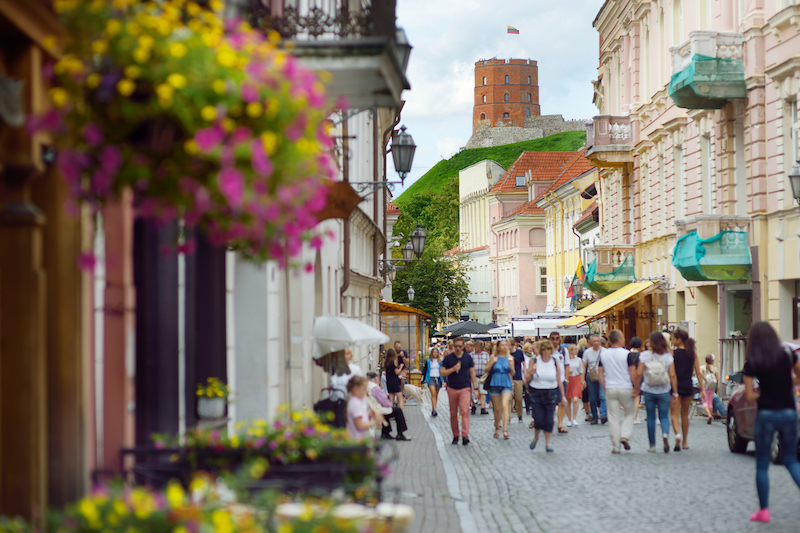 With more than a year since the first wave of the COVID-19 pandemic, Ober-Haus experts have evaluated how the situation has changed in the main shopping streets of Vilnius where the mood has been largely changeable.
“The entire retail and retail property sector in Lithuania has been facing a variety of challenges during this period. Smaller retailers found the period particularly difficult. The rapidly changing pandemic situation in the country, regular need to adapt to changing safety requirements and the limited financial capacity of small businesses have made the tenants of small retail premises particularly vulnerable,” Raimondas Reginis, Market Research Manager for the Baltics at Ober-Haus, said.
A survey on the situation in the main shopping streets (Gedimino Ave., Pilies St., Didžioji St., Vokiečių St.) of the city of Vilnius conducted by Ober-Haus in mid-2020 and mid-2021 shows that the situation is still stressful. If in mid-2020 the vacancy rate in these streets stood at 11.0%, so in mid-2021 it slightly increased to 11.9%.
“In the summer of 2020, people returned to shopping streets and injected optimism to retailers, particularly to the largest group of tenants – restaurants, cafes, bars and fast food outlets, which account for 38% of all retail premises in these streets of the capital city,” Reginis said.
With the lifting of the lockdown, people who have missed socializing and recreation occupied outdoor seating areas of retailers who provide food and beverage services and improved the performance indicators of such retailers. According to Statistics Lithuania, the turnover of food and beverage suppliers in Lithuania in H2 2020 increased by 27% compared to H1 2020. However, the overall performance in H2 2020 in this business sector remained 19% lower compared to record indicators in H2 2019. The second wave of the coronavirus made businesses essentially close again and at the end of 2020 the performance indicators noticeably declined again. In H1 2021, the performance indicators of food and beverage suppliers remained modest and were 9% lower than at the same time last year and 32% lower than in H1 2019.
According to Ober-Haus, in mid-2021, the highest vacancy rate was recorded in Pilies Street – at 18.5% and the lowest vacancy rate was recorded in Didžioji Street (9.1%). The vacancy rate in Gedimino Avenue stood at 11.0% and in Vokiečių Street – 10.2%.
Within a year, the highest increase in vacancy rate was in Pilies Street (from 11.3% to 18.5%), where over 50 retail units are based (located on the ground floor of the building, with at least one window facing the street and suitable for commercial activities).
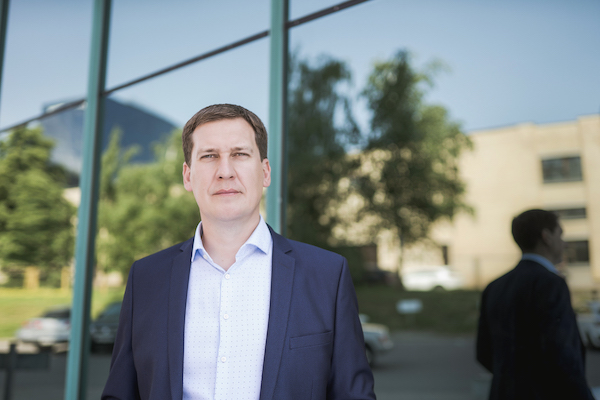
Raimondas Reginis, Market Research Manager for the Baltics at Ober-Haus
“Since the overall number of retailers is not large, a few vacant retail premises can significantly change the relative indicator of the vacant space. On the other hand, Pilies Street is probably the most popular street visited by foreign tourists in Vilnius, so during the pandemic, the footfall decreased significantly affecting revenues of retailers,” Reginis noted.
Meanwhile, on Vokiečių Street there was one vacant space less in mid-2021 than a year ago, and the figure for the vacancy rate decreased from 12.5% to 10.2%. Despite the relatively small vacancy rate, the owners and tenants of this street will be facing additional challenges. This year, the renovation of the district heating system started on Vokiečių Street, and cafes and restaurants have to adapt to the works and to relocate or close their outdoor seating spaces. Once the renovation of the heating system is completed, the renovation of the entire Vokiečių Street will start, and the terms of the reconstruction have not yet been finalised.
“It is clear that the renovation works will significantly reduce the flow of potential customers in the street and this will affect all businesses located in the street, which, in addition, will have to deal with the challenges posed by the current pandemic. Therefore, the owners of retail premises on Vokiečių Street may expect the rise in the number of vacant premises in the coming years and the decrease in rental revenues,” Reginis said.
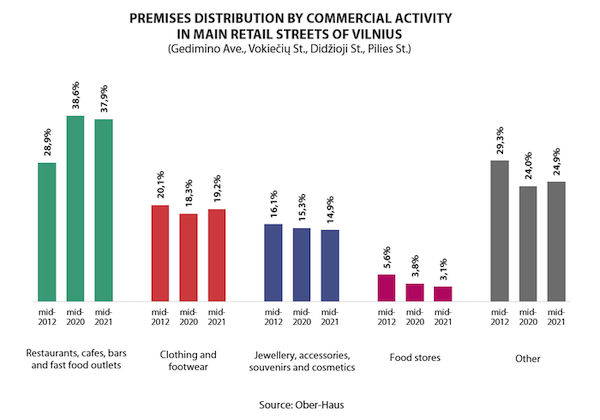
The structure of the tenants in the main shopping streets of the capital city has not changed substantially during the year. According to Ober-Haus, in mid-2021, most of the premises were occupied by restaurants, cafes, bars and fast food outlets and their share during the year decreased slightly from 38.6% to 37.9%. The share of clothing and footwear retailers accounted for 19.2%, jewellery, accessories, souvenirs and cosmetics – 14.9%, food stores – 3.1%, and the remaining 24.9% were beauty salons, offices, pharmacies, banks, bookstores and other retail or services units.
Given that the pandemic situation in the country is either improving or deteriorating, the expectations of the owners of retail premises in respect to the rental income remain uncertain. If some owners of such premises can offer lower rents than they were before to potential tenants, so other owners still expect to sign long-term lease contracts securing pre-pandemic rents.
In mid-2021, rents for medium-sized (about 100–300 sqm) retail premises in the main shopping streets of Vilnius (Gedimino Avenue, Pilies Street, Didžioji Street and Vokiečių Street) stood at 15.0–40.0 EUR/sqm and were on average 12% lower than those at the end of 2019. However, there are cases where owners of the premises sign long-term lease contracts with new tenants at 25-20% lower rents than they could lease before the pandemic started.
The overall indicators show that there is little optimism in the shopping streets of Vilnius, but interest in available retail space is not lost. “Some businesses see long-term prospects of these streets and the current market situation opens up much wider opportunities for them. If it was generally difficult to find suitable premises before the pandemic even by offering historically record rents, today the choice is wider and the rents are more attractive. Therefore, more daring entrepreneurs are trying not to miss their chance and are actively interested in their business development opportunities in the prestigious locations of the city,” Reginis said.
Latest news
 All news

What is worth negotiating when renting an office today?
[caption id="attachment_69024" align="aligncenter" width="2560"] Ugnė Liaudanskienė, Office Leasing Manager at Ober-Haus[/caption] The large supply of new office space in Vilnius keeps rental prices stable, but also encourages more active negotiations between the parties. However, in long-term lease relationships, the most important thing is to balance mutual interests. Especially as the practical value is often determined not only by the price, but also by other aspects of the contract, such as flexibility, terms or additional conditions. In the office market, it has been said for some time now that the scales of power are tipping towards the tenant. Last year, base rents in Class A and B business centres rose by around 2%. Currently, monthly rents in Class A business centres are up to EUR 16-20/sqm, in new, exclusive projects they are as high as EUR 21-23/sqm, and in Class B business centres the prevailing rents are EUR 10-15/sqm. In 2025-2026, more than 100 thousand sqm of usable office space will reach the market. Despite the continuing economic growth, office rental growth is currently constrained by the large supply of vacant space, the ongoing transformation of tele-hybrid working, conservative business expectations and geopolitical reasons. The tenant's market would seem to be…
In 2025 developers built only half as much as buyers purchased
In 2025, the Lithuanian housing market was characterised by a particularly rapid increase in housing sales volumes in both the secondary and primary markets. According to the Ober-Haus review, a particularly rapid recovery was recorded in the primary market of large cities, where buyers were active in purchasing newly built apartments in completed and newly constructed buildings. Of all the apartments actually built and sold on the primary market, the capital city showed the greatest imbalance in 2025. According to Ober-Haus data, developers in Vilnius built 2,787 apartments for sale in apartment buildings in 2025, which was 8% more than in 2024. Meanwhile, over 5,700 apartments were sold on the primary market in Vilnius during the year, representing an increase of 82%. 'This means that developers actually built half as much as the recorded housing demand. Since the project planning and construction process is lengthy and often takes longer than planned, the rapid recovery of the market has left developers unable to meet demand," says Raimondas Reginis, Ober-Haus's market research manager for the Baltic countries. This situation is unfavourable for both buyers and developers. Buyers have limited choice and face rapidly rising prices, while developers are unable to fully exploit…
Sales of Dubysa Namai apartments in Ariogala have begun
The Dubysos Namai housing project in Ariogala is nearing completion. This five-storey residential building has been developed on a 0.75-hectare plot of land in the picturesque Dubysa Valley. This development will provide much-needed new housing for the town's real estate market, where supply has been extremely limited until now. Sales of the apartments have already begun, and prospective buyers can choose from a range of modern, well-designed homes. First-time homebuyer subsidies are available for young families. The development comprises 89 apartments, each with a storage room and parking space. The development will feature a children's playground, leisure areas, lighting and a gated entrance, creating a safe and comfortable environment for residents. Dubysos Namai offers two to four-room apartments ranging from 55 to 110 m² in size with partial finishing. The first phase of apartments has been completed and is ready for new residents to move in, while the second phase of construction is expected to be finished in Q4 of 2026. Almost all apartments have balconies and the option to install a fireplace, offering panoramic views of the Dubysa Valley. Many buyers are surprised that it is possible to install a fireplace in Dubysos Namai apartments. This is a rare…
All news