




Retail properties drive investment market to record levels


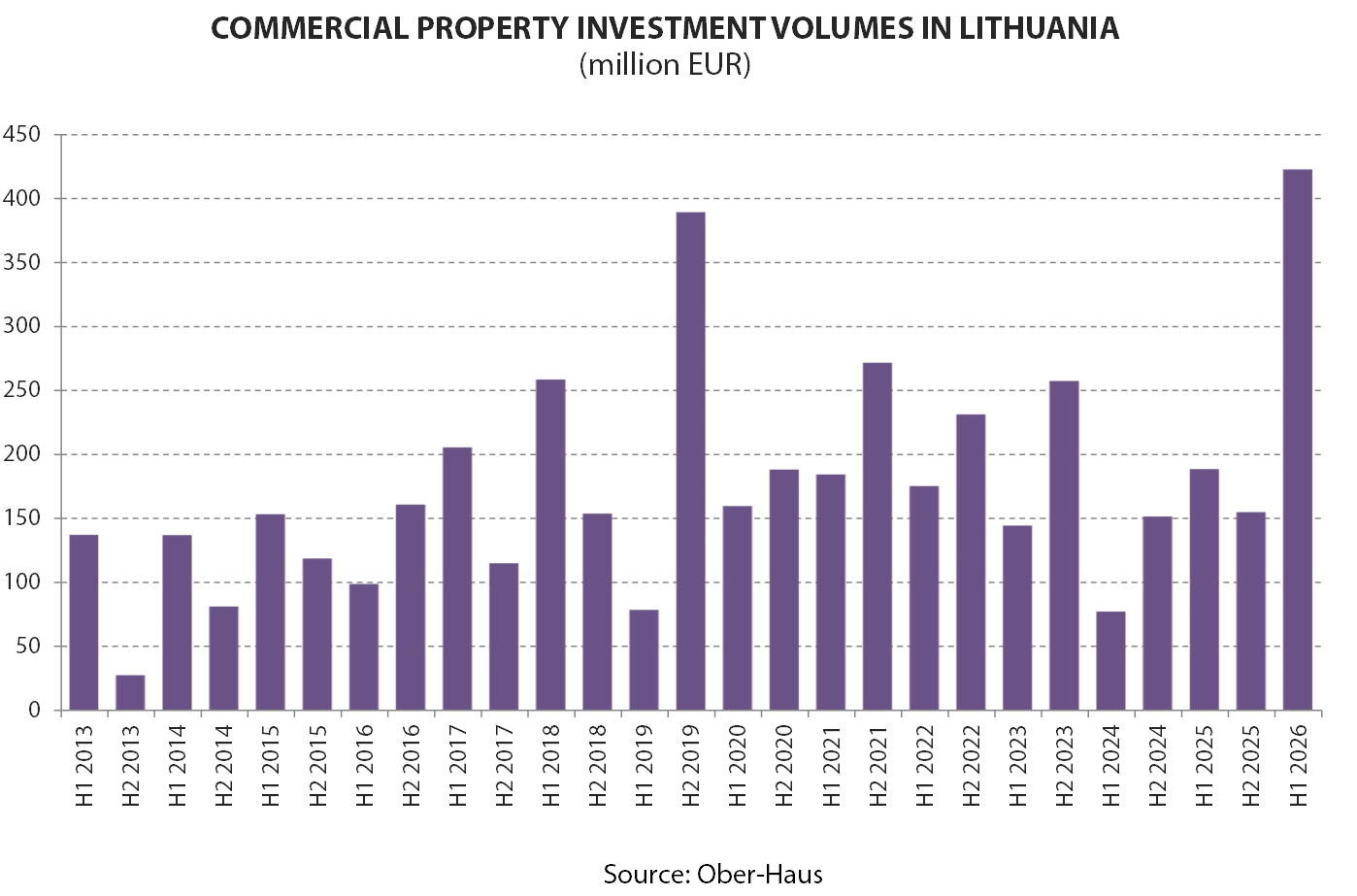
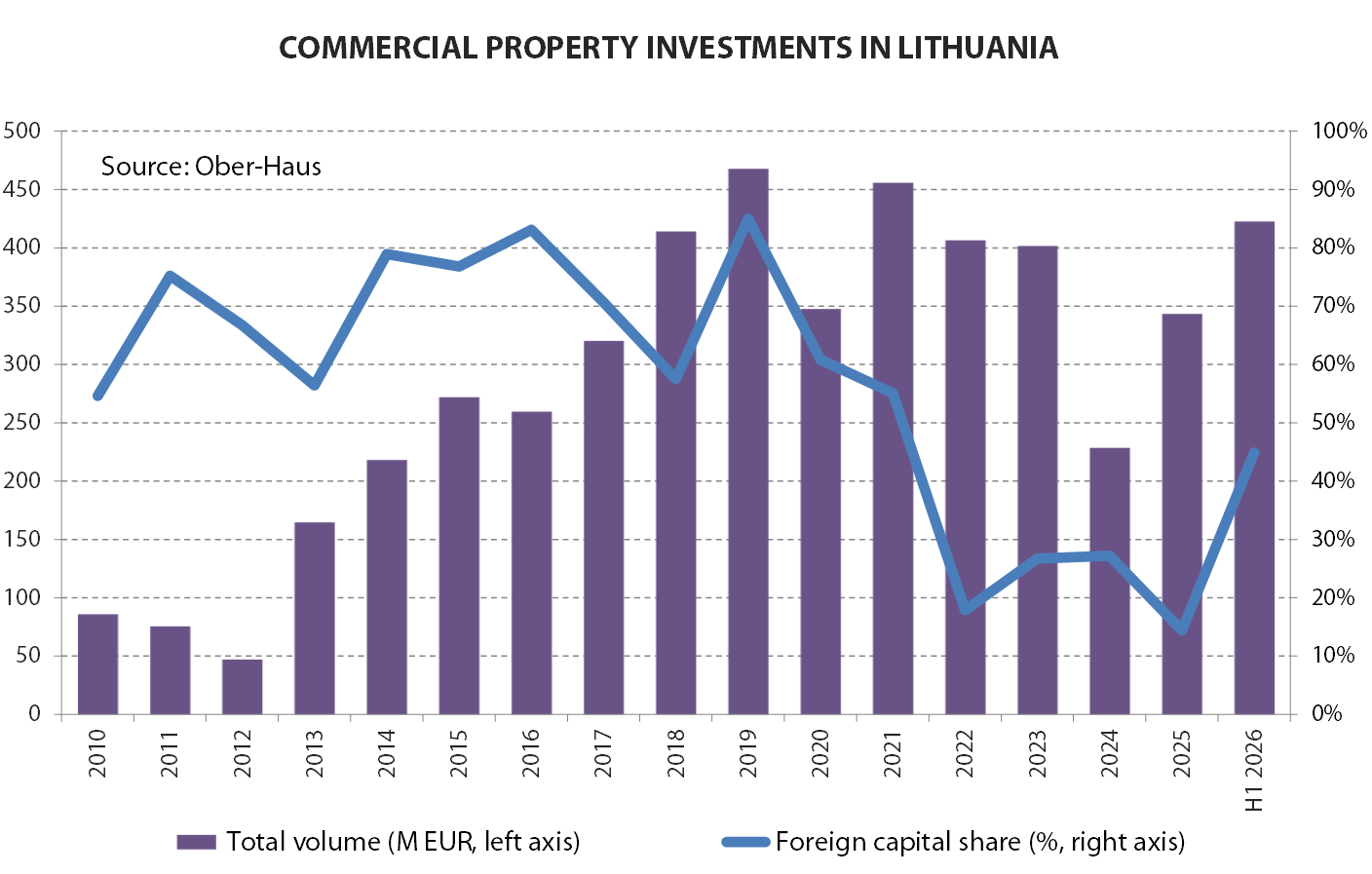
Following a strong 2025, Lithuania’s commercial real estate investment market reached record levels in 2026. According to Ober-Haus, during the first half of 2026, €423 million was invested in modern income-producing commercial real estate in Lithuania, including office, retail, warehouse and industrial properties valued at €1.5 million or more. This was not only the highest six-month investment volume on record, but also came close to the record annual investment levels recorded in 2019 (€468 million) and 2021 (€456 million), according to the latest Ober-Haus market review.
“The first half of 2026 was notable for the diversity of investments and one particularly significant transaction. A total of 40 properties changed hands during the first six months, which is similar to the number recorded over the entire year of 2025,” says Raimondas Reginis, Head of Market Research for the Baltic States at Ober-Haus. The average value of an acquired property exceeded €10 million, while the most expensive assets were valued at more than €30 million. R. Reginis notes that the Vilnius region typically accounts for the largest share of investment, but in the first half of 2026, half of all investment went to other regions of Lithuania, as was also the case in 2025. For example, 10 properties were acquired in the Kaunas region, accounting for 29% of total investment (€123 million).
Retail sector stands out for high investment volumes and transaction diversity
Once again, retail properties attracted the largest share of investment in the first half of 2026, with €274 million invested in the segment, accounting for 65% of total investment in income-producing commercial real estate in Lithuania.
The largest investment transaction in this segment was the acquisition of a portfolio of retail properties and a warehouse across the Baltic states. A subsidiary of “WPC Pan-European Holding”, managed by US investment company “W. P. Carey Inc.”, acquired 19 properties in various Baltic cities for nearly €178 million. The properties are occupied by “Kesko Senukai”, a retail chain specialising in construction, renovation and household goods. In the Baltic states, the assets were owned by “Baltic Retail Properties”, the majority of which had been owned by “W. P. Carey Inc.” through its “CPA 17 Pan-European Holding” since 2017. Another company within the “W. P. Carey Inc.” group acquired a total of 12 properties in Lithuania, with their combined value estimated at more than €100 million. In addition to this large-scale transaction, the retail segment recorded a significant number of acquisitions of varying sizes.
A fund managed by investment company “Prosperus” sold the “Mandarinas” shopping centre in Vilnius to “Hakonlita”, part of Danish retail group “Salling Group”, which acquired the “Rimi Baltic” retail chain in the Baltic states in 2025. “Prosperus” also sold the “Kalnėnai” shopping centre in Vilnius, a shopping centre in Palanga on Klaipėdos pl. and a shopping centre on Vingio g. in Klaipėda.
In mid-2026, French real estate investment management company “Corum” sold a “Depo” store in Kaunas back to the Latvian retail chain. Between 2019 and 2021, “Corum” acquired four “Depo” stores in Lithuania, making this the second store that the investor has since sold back to the Latvian retailer.
Meanwhile, Finnish real estate investment fund “Titanium Baltic Real Estate” sold a “Senukai” store in Vilnius, which it had acquired in 2022. Alongside these larger transactions, a considerable number of smaller retail properties were also acquired in cities across Lithuania.
High-quality, fully leased office buildings remain in demand
The office segment has not seen particularly strong investment activity in recent years, but several larger transactions were completed in the first half of 2026, pushing total investment above the levels recorded in both 2024 (€69 million) and 2025 (€71 million). According to Ober-Haus estimates, investors spent a total of €85 million on office properties during the first half of the year, accounting for 20% of all investment in commercial real estate in Lithuania.
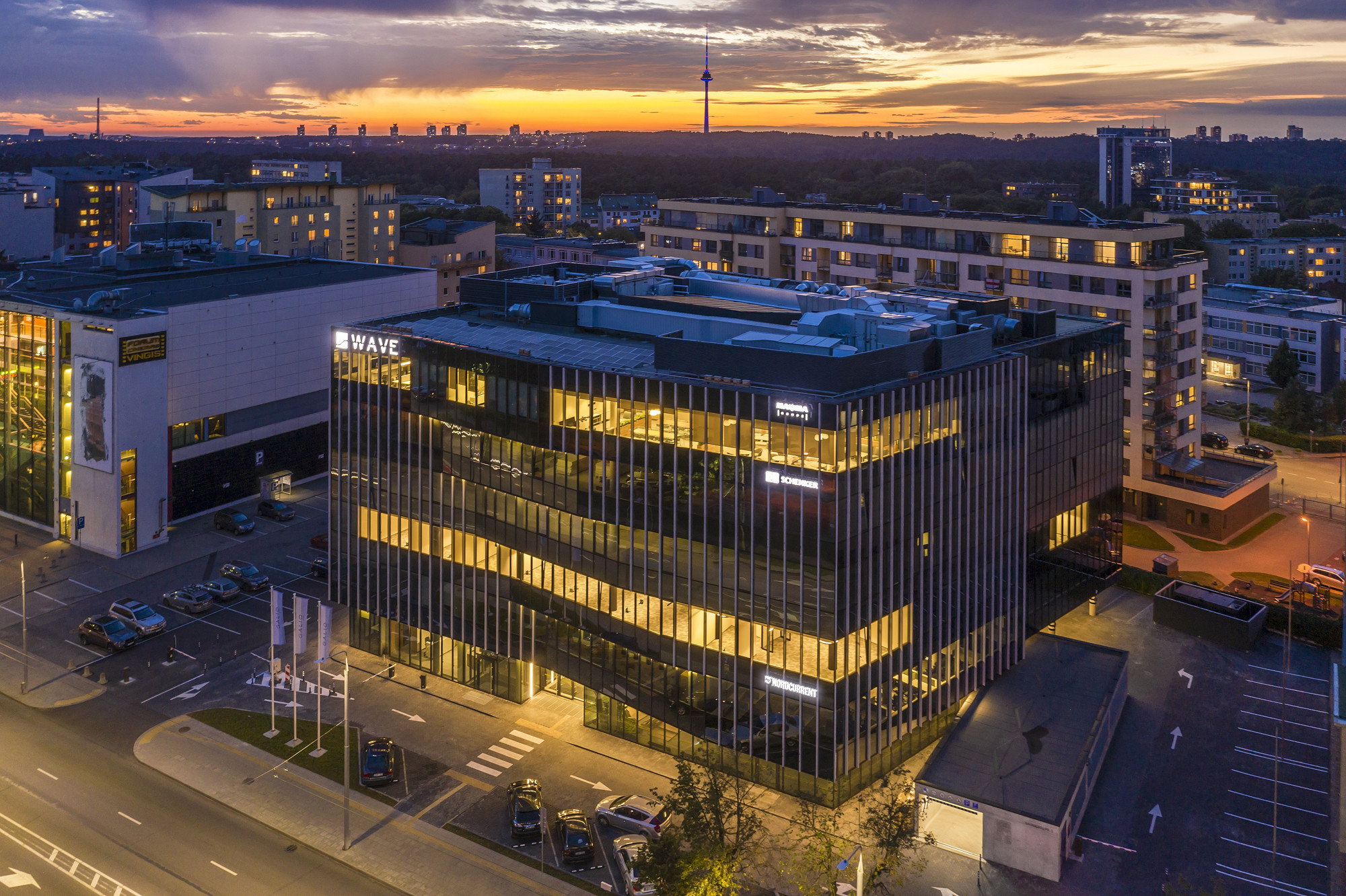
“Groa Real Estate Opportunity Fund”, managed by Lithuanian investment company “Groa Capital”, acquired the “Wave” office building in Vilnius. The nearly 10,000 sq m office building in Naujamiestis was developed and sold by real estate development company “Galio Group”. Meanwhile, real estate development and construction company “YIT Lietuva” sold the “Sky Office” business centre in Vilnius, completed at the end of 2023. The nearly 9,000 sq m building was acquired by a fund managed by “Evernord Asset Management”.
Investment company “Taba Invest”, meanwhile, acquired a majority stake from other shareholders in the company that owns the “Yellowstone” office building in Vilnius, completed in 2024. “While investors developing projects typically seek to sell a completed and fully leased property on the open market, there are cases where the asset is acquired by a related investor or a newly established fund managed by the same asset management company,” R. Reginis notes.
Another major transaction took place in Kaunas, where a fund managed by investment company “Nter Asset Management” sold its shares in the company that owns an office building on K. Baršausko g. The approximately 5,000 sq m office building was acquired in 2017 from its developer, “YIT Lietuva”.
Growing warehouse and retail warehouse segment attracts investors
According to Ober-Haus, the warehouse and industrial property segment attracted €64 million in investment during the first half of 2026, accounting for 15% of total investment in commercial real estate in Lithuania.
Real estate development company “Sirin Development” sold a 16,000 sq m warehouse in Kaunas Free Economic Zone to “Araneta”, the company behind the “Baldų turgus” brand. The company had been leasing the warehouse before acquiring it for €16 million in the middle of this year.
In addition to conventional warehouses, the market is now seeing the first transactions involving retail warehouse (“stock-office”) properties. “These properties can provide businesses of various sizes with all the functions they need in one location — storage, distribution and product display, as well as modern workspaces for employees. This segment has experienced particularly rapid growth over the past five years. Since 2020, dozens of projects of various sizes have been developed in the Vilnius, Kaunas and Klaipėda regions, with a combined area of around 250,000 sq m,” R. Reginis explains.
A fund managed by “Prosperus” acquired the 13,000 sq m “Vikingų verslo parkas” development in Vilnius for more than €21 million from its developer, real estate development company “VPH”. Earlier this year, “Omberg Group” also announced an agreement with “Kamida Group” to sell the more than 7,000 sq m “Stockholm” retail warehouse development in Kaunas. The transaction was formally completed in July.
Confidence among investors familiar with the local market is growing
Several larger transactions involving foreign-owned companies were completed in the first half of 2026, significantly increasing the share of foreign capital in the market. According to Ober-Haus, the share of capital controlled by foreign investors in Lithuania’s investment transactions fell to a record low of 14–27% between 2022 and 2025. In the first half of 2026, however, the share had risen to 45%.
Despite the increased share of foreign investment, no significant new foreign investors have entered the Lithuanian real estate market so far. “The investment transaction market continues to be dominated by Lithuanian-owned companies and foreign investors that have already been active in Lithuania for a longer period and acquire commercial real estate either for their own operations — such as retail or manufacturing companies — or as an investment. At the same time, the recent growth in investment volumes and the increasing diversity of transactions clearly indicate that overall investor confidence in Lithuania’s commercial real estate market is recovering,” says R. Reginis.
Latest news
 All news

Buyers are paying €20,000 more for standard apartments than a year ago
The Ober-Haus Lithuanian Apartment Price Index (OHBI), which tracks apartment price changes in Lithuania’s five largest cities (Vilnius, Kaunas, Klaipėda, Šiauliai and Panevėžys), increased by 1.2% in September 2026. Over the past 12 months, apartment prices across these cities have risen by 13.7%, unchanged from the annual growth rate recorded in August 2026. In September 2026, apartment prices increased by 0.9% in Vilnius, 1.7% in Kaunas, 1.1% in Klaipėda, 2.0% in Šiauliai and 2.8% in Panevėžys. The average price per square metre reached €3,197 in Vilnius (+€27/m²), €2,339 in Kaunas (+€39/m²), €2,103 in Klaipėda (+€23/m²), €1,457 in Šiauliai (+€28/m²) and €1,432 in Panevėžys (+€39/m²). Year-on-year, apartment prices rose in all five cities. Compared to September 2025, prices increased by 12.2% in Vilnius, 16.8% in Kaunas, 12.9% in Klaipėda, 17.3% in Šiauliai and 17.5% in Panevėžys. “Even the recent acceleration in housing price growth has not slowed activity in the real estate market. According to data from the State Enterprise Centre of Registers, the number of apartments purchased nationwide in the third quarter of this year was 2.1% higher than in the same period last year, while house purchases increased by 13.3%. Meanwhile, apartment prices in Lithuania’s major cities are rising…

A new 40-apartment development, “Matau marias”, is being built on the shores of the Ekranas Lagoon in Panevėžys
A new real estate development, “Matau marias”, is being built in Panevėžys by the Ekranas Lagoon. At Elektronikos g. 10, four low-rise buildings are planned, comprising 40 leisure-use apartments with partial interior finishing. The apartments will range in size from 28 to 96 sq. m. Construction began in August 2026 and is scheduled for completion by the end of 2027. One of the development’s key features is its location directly beside the Ekranas Lagoon. The buildings are surrounded by greenery, while the site is closely integrated with the lagoon’s shoreline. The development will include pedestrian paths, landscaped green and recreational areas, an upgraded waterfront, and a private jetty for apartment owners. “Living by the water is usually associated with the countryside or resort towns, so a location like this in Panevėžys itself is quite rare. Here, the water and nature are not simply part of the view – the lagoon’s shoreline becomes a natural extension of the development. At the same time, the city centre remains just a few minutes away,” says Justina Ščeponavičė, Head of Sales for the project. Four low-rise buildings and just 40 apartments “Matau marias” consists of four low-rise buildings connected by a cohesive landscape concept…

Optimism continues to support housing price growth
The August 2026 value of the Ober-Haus Lithuanian Apartment Price Index (OHBI), which tracks apartment price changes in the five largest cities in Lithuania (Vilnius, Kaunas, Klaipėda, Šiauliai and Panevėžys), increased by 1.8%. Over the past 12 months, the overall apartment price level in Lithuania’s major cities rose by 13.7% (in July 2026, annual growth stood at 12.9%). In August 2026, apartment sale prices in Vilnius, Kaunas, Klaipėda, Šiauliai and Panevėžys increased by 1.6%, 2.1%, 2.3%, 1.0% and 1.3%, respectively. The average price per square metre reached €3,170 (+€50/m²), €2,300 (+€47/m²), €2,080 (+€48/m²), €1,429 (+€14/m²) and €1,393 (+€18/m²), respectively. Over the year (August 2026 compared with August 2025), apartment prices increased in all major cities across Lithuania: by 12.7% in Vilnius, 16.4% in Kaunas, 12.9% in Klaipėda, 15.8% in Šiauliai and 14.6% in Panevėžys. “Despite considerable expectations regarding the impact of the second-pillar pension reform and changes to the Responsible Lending Regulations on the Lithuanian housing market, we have not observed a significant surge in market activity recently. According to data from the State Enterprise Centre of Registers, 2.5% more apartments and houses were purchased in Lithuania this August than in the same month last year, but 4.7% fewer than…
All news