




Real estate markets of the capital cities of the Baltic countries – productive year behind and ahead


 As it was expected and forecast, the year 2018 was truly active in the real estate markets of the Baltics. In the environment of the growing economy, high supply and demand indicators continue to be recorded in the capitals of the Baltics and other major cities. As noted in the latest annual real estate market report of the capital cities of the Baltics by Ober-Haus, the upward trend is observed both in the commercial and residential property markets.
“If since the last economic downturn we have seen a sufficiently rapid recovery in the real estate markets of the capital cities of Estonia and Lithuania, the capital of Latvia, Riga, could not boast of greater changes. It seems, however, that the largest city of the Baltic countries is finally entering into a faster development phase,” Raimondas Reginis, Research Manager for the Baltics at Ober-Haus, said.
Leap in supply in the office market in Riga in 2019–2020
In 2018, 80,000 sqm of new office space was built in Tallinn, 43,000 sqm in Vilnius and nearly 25,000 sqm in Riga. Although in terms of the new office space, Riga was again behind Tallinn and Vilnius in 2018, according to Mr Reginis, the office sector in the biggest city in the Baltics is gaining momentum. According to Ober-Haus, a significant amount of office space of up to 140,000 sqm should supplement the market in Riga in 2019–2020.
“In the next two years developers in Riga plan to build as much office space as there was built in the past nine years (2010-2018). This is exactly what the capital city of Latvia lacked in order to compete with Vilnius and Tallinn for the attention of international companies. A possibility not only to get established, but also to plan any further expansion in modern buildings is one of the main factors for bringing larger companies to a specific region or city,’ Mr Reginis pointed out.
Vilnius and Tallinn, however, are not going to give up their positions as leaders in the office space development in the past decade easily and are also preparing for new impressive office developments. According to Ober-Haus, at least 15 projects are planned to be implemented in Vilnius in 2019–2020, offering a useful office space of about 160,000 sqm. In Tallinn, about 100,000 sqm are planned to be built during the same period.
Two new large shopping centres in Tallinn and Riga
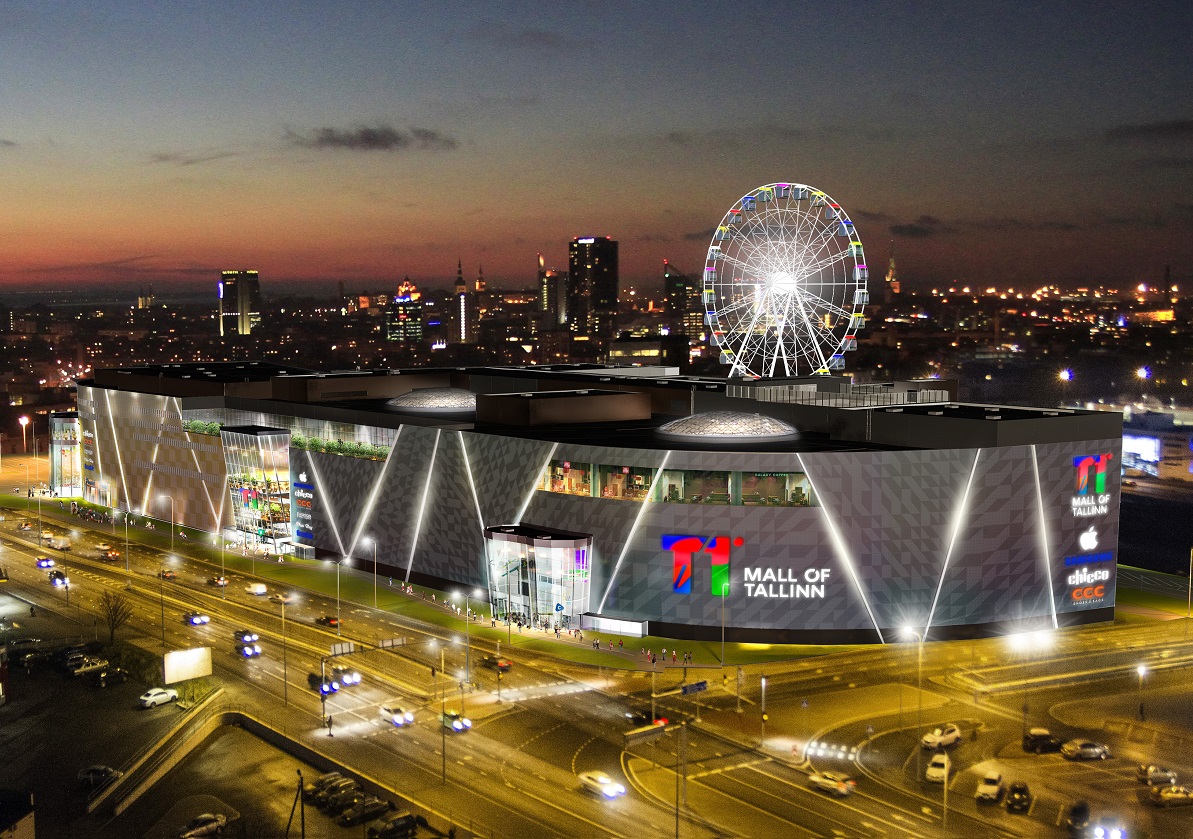 In the sector of traditional larger shopping centres, Tallinn and Riga had the biggest news in 2018–2019. Following the opening of T1 Mall of Tallinn at the end of 2018 the market in Tallinn was supplemented with 55,000 sqm of retail space. According to Ober-Haus, the retail space in traditional shopping centres in the capital of Estonia at the end of 2018 totalled 665,300 sqm and with 1.54 sqm per capita remains the obvious leader among the capitals of the Baltics.
In the meantime, after a long break one of the largest retail projects was implemented in Riga. In April 2019, Akropole shopping centre was opened supplementing the market in Riga with around 60,000 sqm of retail space. In terms of the retail space per capita, Riga came second in 2018 among the capitals of the Baltics (649,000 sqm or 1.02 sqm/capita). Following the opening of Akropole, the retail space indicators in Riga increased by a tenth.
“Despite the opening of smaller scale projects and DIY type schemes (Žali, Depo, Decathlon) in Vilnius in 2018, no larger traditional shopping centres were built,” Mr Reginis said. Opening of a larger project can be expected at the end of 2020, when the Vilnius Outlet shopping centre will be opened next to the western bypass of the city supplementing the market in the capital with about 35,000 sqm of retail space. The project of this type will be implemented in Vilnius after a break of 4.5 years (since the opening of the second stage of Nordika shopping centre in May 2016). According to Ober-Haus, the retail floor area in the traditional shopping centres in Vilnius at the end of 2018 totalled 453,000 sqm or 0.82 sqm per capita, the smallest figure out of the capital cities of the Baltic countries.
200,000 sqm new warehousing space in the capitals of the Baltics countries
In 2018, the capital cities of the Baltics and their environs saw particularly huge volumes of construction of warehousing facilities. “The growing demand for modern warehousing space and high occupancy rates create conditions for much faster expansion of this sector,” Mr Reginis said. The vacancy rate of modern warehousing premises in the Baltics is under 5%.
According to Ober-Haus, a total of 16 projects were implemented in the capital cities and their environs in 2018, offering a little over 200,000 sqm of warehousing premises: about 86,000 sqm in Tallinn, about 60,000 sqm in Riga and nearly 58,000 sqm in Vilnius.
The largest supply of modern warehousing facilities in the Baltic countries is in Tallinn and its environs. At the end of 2018, the total area of these premises in Tallinn was over 1.3 million sqm. Meanwhile in Riga and its environs the total area of warehousing premises increased by 9% in 2018 totalling almost 709,000 sqm. According to Ober-Haus, the supply of warehousing premises in Vilnius and its environs increased by 11% in 2018 and at the end of the year totalled slightly over 585,000 sqm.
“Unlike in Estonia and Latvia, where the warehousing sector is mainly concentrated in the country’s capitals and its surroundings, Lithuania has other regions with sufficiently active development of warehouses. The supply of warehousing premises in Kaunas and Klaipėda regions alone totals almost 550,000 sqm,” – Mr. Reginis noted.
According to the representative of Ober-Haus, the development of warehousing facilities gained impetus and shows no signs of stopping soon. In 2019, a considerable increase in such property is planned in the capitals of the Baltics. Projects of different size are planned which will offer approximately 130,000 sqm of warehousing space.
Tallinn is catching up with Vilnius according to the construction volumes of multi-apartment buildings
 In 2018, the fastest leap in the supply of apartments in the capitals of the Baltic countries was recorded in Riga. A little over 2,400 apartments were built in a year or 65% more than in 2017. “Of course, the scale of apartment development in Riga still lags behind that in Vilnius and Tallinn, but the leap shows much more ambitious steps taken by developers,” the representative of Ober-Haus noted. In 2018, over 4,300 apartments (5% more than in 2017) were built in Vilnius and 3,100 apartments were built in Tallinn (7% more than in 2017).
Despite the fact that according to the quantity of new apartments Vilnius retained the position of the leader among the capitals of the Baltics in 2018, Tallinn is rapidly catching up. According to Ober-Haus, in 2014–2016, on average 6.1 apartments were built per 1,000 population in Vilnius annually and in 2017–2019 the figure will increase to 7.9 apartments. At the same time in Tallinn on average 3.9 apartments per 1,000 population was built annually in 2014–2016 and in 2017–2019 the figure will jump to 7.1 apartments.
“It means that in terms of the number of apartments built in Tallinn, it is only by a tenth percentage points behind Vilnius,” Mr Reginis said. At the same time, despite a significant rise in the number of new apartments built in 2018 in Riga, the volumes of apartment construction in Riga remain modest and the figure is more than half that of Vilnius and Tallinn. According to Ober-Haus, in 2017–2019, the figure will be 3.1 completed apartments per 1,000 population in Riga.
“It is obvious that 2019–2020 will certainly not be boring in the real estate markets in the Baltic countries and will be eventful. The economic environment continues to remain favourable for active development of the market in the main regions of these countries. It is clear that developers are not going to miss this opportunity,” Mr Reginis said.
Latest news
 All news

In 2025 developers built only half as much as buyers purchased
In 2025, the Lithuanian housing market was characterised by a particularly rapid increase in housing sales volumes in both the secondary and primary markets. According to the Ober-Haus review, a particularly rapid recovery was recorded in the primary market of large cities, where buyers were active in purchasing newly built apartments in completed and newly constructed buildings. Of all the apartments actually built and sold on the primary market, the capital city showed the greatest imbalance in 2025. According to Ober-Haus data, developers in Vilnius built 2,787 apartments for sale in apartment buildings in 2025, which was 8% more than in 2024. Meanwhile, over 5,700 apartments were sold on the primary market in Vilnius during the year, representing an increase of 82%. 'This means that developers actually built half as much as the recorded housing demand. Since the project planning and construction process is lengthy and often takes longer than planned, the rapid recovery of the market has left developers unable to meet demand," says Raimondas Reginis, Ober-Haus's market research manager for the Baltic countries. This situation is unfavourable for both buyers and developers. Buyers have limited choice and face rapidly rising prices, while developers are unable to fully exploit…
Sales of Dubysa Namai apartments in Ariogala have begun
The Dubysos Namai housing project in Ariogala is nearing completion. This five-storey residential building has been developed on a 0.75-hectare plot of land in the picturesque Dubysa Valley. This development will provide much-needed new housing for the town's real estate market, where supply has been extremely limited until now. Sales of the apartments have already begun, and prospective buyers can choose from a range of modern, well-designed homes. First-time homebuyer subsidies are available for young families. The development comprises 89 apartments, each with a storage room and parking space. The development will feature a children's playground, leisure areas, lighting and a gated entrance, creating a safe and comfortable environment for residents. Dubysos Namai offers two to four-room apartments ranging from 55 to 110 m² in size with partial finishing. The first phase of apartments has been completed and is ready for new residents to move in, while the second phase of construction is expected to be finished in Q4 of 2026. Almost all apartments have balconies and the option to install a fireplace, offering panoramic views of the Dubysa Valley. Many buyers are surprised that it is possible to install a fireplace in Dubysos Namai apartments. This is a rare…

The Šiauliai housing market is expected to see a more moderate second half of the year
Although housing prices in Šiauliai rose by 11% in 2025 and remained active at the beginning of this year, the market is expected to stabilise in summer or autumn, according to forecasts by Ober-Haus. According to data from the Centre of Registers, a total of 1,539 apartments and 253 houses were purchased in Šiauliai in 2025, representing increases of 22.9% and 22.4%, respectively, compared to 2024. According to Ober-Haus calculations, the average price of apartments in Šiauliai was €1,273 per square metre at the end of last year, which is 11% higher than a year ago. According to the company's data, the price of typical old apartments in residential areas of Šiauliai currently ranges from €1,200 to €1,800 per square metre, depending on furnishings, location and the condition of the building. Prices for newly built apartments with partial finishing in residential areas range from €2,000 to €2,800 per square metre, whereas in the city centre or the old town, prices per square metre can reach €2,500 to €3,200. Linas Juozaitis, head of the Šiauliai Ober-Haus office, comments that the highest market activity and price growth in the city was observed in the second half of last year, and similar trends…
All news