



Real estate markets in the Baltic countries are experiencing varying degrees of difficulties, yet at the same time opening up opportunities for the most active participants



The year 2023 was full of challenges for the real estate markets of the Baltic countries showing some early signs of this back in 2022. Last year, Baltic countries saw an economic slowdown, declining activity in the residential and commercial real estate market, rising number of unsold apartments, higher office vacancy rates and slowing construction volumes. According to the Ober-Haus annual Real Estate Market Report on the capital cities of the Baltic countries, it is clear that the sentiment of homebuyers, businesses and investors alike has slumped and confidence in the Baltic real estate market as a whole has further eroded.
While the general sentiment of the real estate market participants is similar across the Baltic countries, the overall impact of global factors (Russia-Ukraine war, high inflation, interest rate hikes) differs to a varying degree.
“Since the real estate market in Latvia and its capital city has lacked fast growth in the last five years, the impact of the current challenges is not as tangible as in other countries,” Raimondas Reginis, Head of Market Research for the Baltics at Ober-Haus, said. Meanwhile, real estate markets in Estonia and Lithuania experienced an investment boom in the aftermath of Covid-19, resulting in a very rapid growth in the housing market activity and a surge in prices. Therefore, the slowdown of the last few years has been most felt in the markets of Lithuania and Estonia, which have moved into a much slower phase of development, particularly noticeable among market participants who got accustomed to a period of record activity. According to Reginis, the market slowdown is particularly steep in Estonia, where after a slight recession in 2022, the economy contracted by as many as 3% in 2023. Unlike in Latvia and Lithuania, recovery is not expected in Estonia this year. This does not only mean a weaker sentiment in the property market in this country, but also affects the general expectations of the population, which remain among the lowest in Europe.
Despite the more challenging period, real estate markets in the Baltic countries have managed to avoid the worst-case scenario, which is usually characterised by a substantial decline in rents or sales prices.
“A fairly stable situation in the labour market, real wage growth, solid savings of the population and the low overall level of indebtedness have protected real estate market participants from hasty decisions or emergency choices and, at the same time, from negative price changes. It is clear, however, that over the last few years, buyers have significantly strengthened their positions in the market and are often the ones who dictate the terms rather than sellers. Therefore, sellers who need to dispose of their property more quickly remain in a more difficult situation,” Reginis noted.
The analysis of the completed housing transactions shows that a small number of potential buyers are able to take advantage of this situation and purchase homes at prices slightly lower than those normally seen in the market. A similar situation can be observed in the commercial real estate market, where the number of investors (particularly foreign investors) has dropped and the yield on commercial real estate has increased by around 50-100 basis points in 2023 alone.
The first half of 2024 has not made real estate market participants more optimistic, because the key market indicators of the last few years remain low and it may take a little longer than previously expected for the real estate market to regain the confidence of market participants. “It is therefore clear that in 2024 both first-time home buyers and larger investors will still be able to find attractive offers on the real estate market of the Baltic countries. It is important not to miss this opportunity, because the real estate market is not stagnant and there are plenty of buyers looking for the best option on the market,” Reginis added.
Read more in the 2024 Ober-Haus annual Real Estate Market Report on the capital cities of the Baltic countries. The report covers the office, retail, warehousing, residential and land markets in each of the capital cities – Riga, Tallinn and Vilnius. The report also includes a section on taxes prepared by the audit, accounting and consultancy company PricewaterhouseCoopers and a section that contains legal information prepared by Sorainen Law Firm.
Full review (PDF): Baltics Real Estate Market Report 2024
Latest news
 All news
A new 40-apartment development, “Matau marias”, is being built on the shores of the Ekranas Lagoon in Panevėžys
A new real estate development, “Matau marias”, is being built in Panevėžys by the Ekranas Lagoon. At Elektronikos g. 10, four low-rise buildings are planned, comprising 40 leisure-use apartments with partial interior finishing. The apartments will range in size from 28 to 96 sq. m. Construction began in August 2026 and is scheduled for completion by the end of 2027. One of the development’s key features is its location directly beside the Ekranas Lagoon. The buildings are surrounded by greenery, while the site is closely integrated with the lagoon’s shoreline. The development will include pedestrian paths, landscaped green and recreational areas, an upgraded waterfront, and a private jetty for apartment owners. “Living by the water is usually associated with the countryside or resort towns, so a location like this in Panevėžys itself is quite rare. Here, the water and nature are not simply part of the view – the lagoon’s shoreline becomes a natural extension of the development. At the same time, the city centre remains just a few minutes away,” says Justina Ščeponavičė, Head of Sales for the project. Four low-rise buildings and just 40 apartments “Matau marias” consists of four low-rise buildings connected by a cohesive landscape concept…
Optimism continues to support housing price growth
The August 2026 value of the Ober-Haus Lithuanian Apartment Price Index (OHBI), which tracks apartment price changes in the five largest cities in Lithuania (Vilnius, Kaunas, Klaipėda, Šiauliai and Panevėžys), increased by 1.8%. Over the past 12 months, the overall apartment price level in Lithuania’s major cities rose by 13.7% (in July 2026, annual growth stood at 12.9%). In August 2026, apartment sale prices in Vilnius, Kaunas, Klaipėda, Šiauliai and Panevėžys increased by 1.6%, 2.1%, 2.3%, 1.0% and 1.3%, respectively. The average price per square metre reached €3,170 (+€50/m²), €2,300 (+€47/m²), €2,080 (+€48/m²), €1,429 (+€14/m²) and €1,393 (+€18/m²), respectively. Over the year (August 2026 compared with August 2025), apartment prices increased in all major cities across Lithuania: by 12.7% in Vilnius, 16.4% in Kaunas, 12.9% in Klaipėda, 15.8% in Šiauliai and 14.6% in Panevėžys. “Despite considerable expectations regarding the impact of the second-pillar pension reform and changes to the Responsible Lending Regulations on the Lithuanian housing market, we have not observed a significant surge in market activity recently. According to data from the State Enterprise Centre of Registers, 2.5% more apartments and houses were purchased in Lithuania this August than in the same month last year, but 4.7% fewer than…
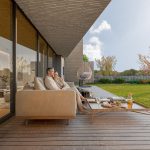
New residential development “Keturlapio skveras” completed in Didieji Gulbinai
A new residential development, “Keturlapio skveras”, has been completed in Didieji Gulbinai, Vilnius, next to Verkiai Regional Park and Lake Gulbinas. The project, located on Sėkmės Street, comprises 24 A++ energy-class semi-detached homes, with sales progressing actively. The development features four- and five-bedroom, one- and two-storey homes ranging from 130 to 170 sq. m, set on plots of 6 to 9 ares. The homes are being sold with partial finishes, completed terraces and fully landscaped surroundings. “Keturlapio skveras” has been designed as a cohesive, gated residential development. The site will be fenced, with controlled access, street lighting and a video surveillance system. The internal road ends in a cul-de-sac, ensuring that there is no through traffic within the development. Residents will also have access to an 18-are recreational park featuring illuminated pathways, a children’s playground and a landscaped leisure area. “This project is aimed at buyers looking for a premium home who value a thoughtfully planned environment, proximity to nature and a strong sense of community. Here, it is not just about the house and its plot – the project also creates the infrastructure of the entire development and a shared recreational space. Particular attention has been paid to the…
All news